
Email today to buy or store your DASEIN System 6 can carton today.
[email protected]

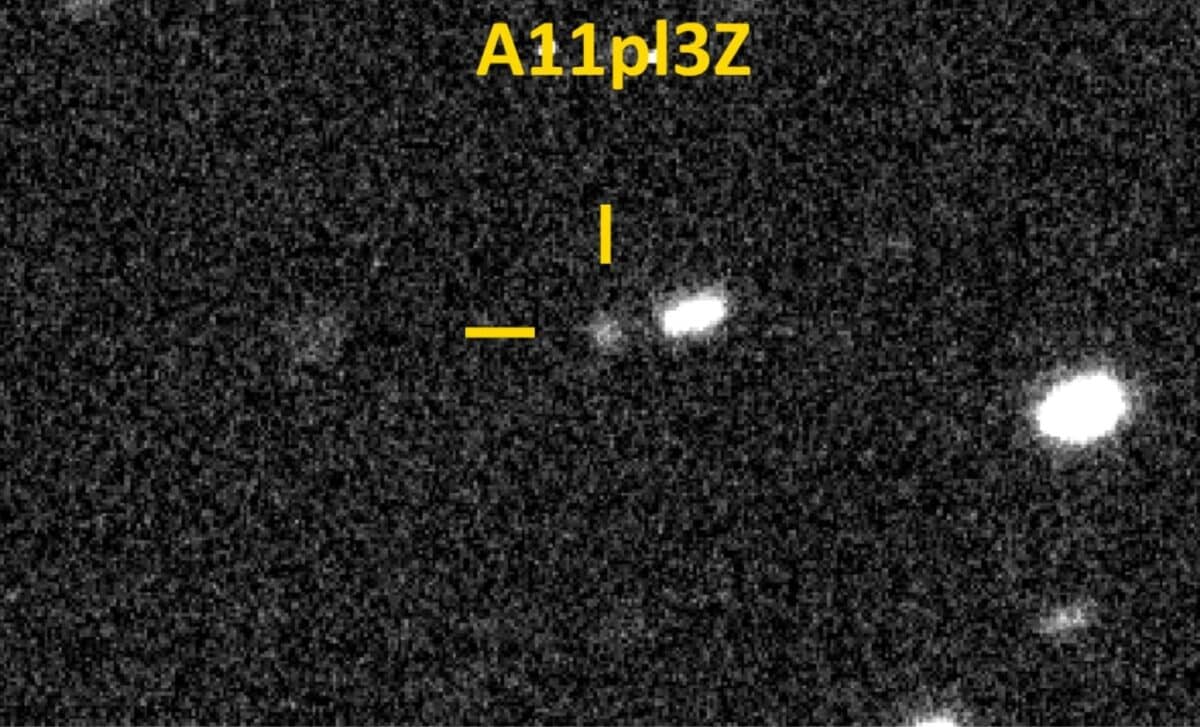
A11pl3Z
A mysterious visitor from another star is getting close
A giant interstellar object named #A11pl3Z is speeding toward our Sun from deep space.
It’s not from our solar system, its strange path proves that. Around 20 km wide, it's far bigger than the earlier visitors like #Oumuamua.
It's moving at nearly 68 km/s and will pass near Mars and the Sun later this year. Scientists still don’t know if it’s a comet or asteroid, but it could carry clues from another star system.
https://x.com/SpaceMechanicsY/status/1940501810428752343?t=dL00HmgXVSZkAY574EEncw&s=19
A new third interstellar visitor -probably an asteroid- A11pl3Z has been discovered on July 1.
It has a high eccentric hyperbolic orbit (65km/sec speed) & size 20km. Its perihelion will be on October 29, 2025.
GIF: K Ly/Deep Random Survey, Chile
🧵What if ʻOumuamua was just step one... and A11pl3Z is the follow-up?
Back in 2017, something strange flew through our solar system.
It didn’t stop or orbit, it just passed through.
Let's discuss 'the Mothership theory'👇
https://x.com/UAPWatchers/status/1940745360131145732?t=EnBoNNEk9ZOT0qLtcBvoBw&s=19
2/
Scientists named it ʻOumuamua, which means "scout" or "messenger" in Hawaiian.
And that’s exactly how it acted.
It showed up unannounced, did a quick pass, and disappeared. Harvard astrophysicist Avi Loeb openly suggested it could be alien tech, possibly a solar sail or autonomous probe.
3/
Now in 2025, we’ve got A11pl3Z.
It’s coming in from interstellar space like ʻOumuamua, but this one’s bigger, possibly over 200 meters across and it’s heading closer to the Sun.
Just like before, no tail, no emissions. It’s quiet, too quiet.
4/
This is where my theory gets weird!
What if ʻOumuamua was a scout sent ahead to observe and collect data, and A11pl3Z is the larger craft? Something that follows up once the scan is complete?
Not here to land, just to pass through again, but slower and maybe even watching.
5/
Think about how we’d explore deep space.
First you send a lightweight probe, something cheap and fast, to sniff around a target star system. Then later, you send the real hardware, the data retriever, the mothership.
Why wouldn’t someone or something else do the same?
6/
If A11pl3Z starts shedding smaller objects, changes speed in a way physics can't explain, or shows material that reacts unnaturally to sunlight, it’s going to get very real, very fast.
And this time, we’ve got the instruments to watch it.
7/
A11pl3Z will be monitored closely as it swings past the Sun. If it's just another space rock, we’ll know soon enough.
But if it isn’t, we might be witnessing something no generation before us has ever seen with clarity.
A second pass, a second look.
8/
No lights in the sky, or broadcast to Earth.
Just something drifting through, scanning quietly. Maybe artificial or possibly ancient.
ʻOumuamua came and went. Now something else is on approach, and that should at least make you wonder.
9/
Of course this is just theory and wild speculation, but there is always a chance that this could be confirmation, that we are not alone! 🧵/End
Follow for more weird and wonderful threads!
Retweet if you enjoyed!
Source:
uapwatchers.com/oumuamua-scout…
#ufotwitter #uapX #A11pl3Z #Oumuamua
https://x.com/UAPWatchers/status/1940745381790314542?t=XE33sXm7eEwj3t8ge3bSww&s=19
If you're worried about ticks, put up an owl box.
The animal driving most Lyme disease in the eastern US is the white-footed mouse. Ticks that feed on them are far more likely to come away infected than ticks that feed on other animals. The bigger the local mouse population, the worse the next year's tick year.
A single barred owl pair raising chicks can take hundreds of rodents in a breeding season. Owls also don't carry Lyme. The bacterium can't survive their digestive tract, so an owl that eats an infected mouse is a dead end for the disease.
Researchers at the Cary Institute, the leading lab on Lyme ecology, have been explicit about this: "Landscapes that support predators have reduced Lyme disease risk."
One owl box on its own isn't going to fix a tick year. But a yard with owls, foxes, bobcats, and weasels in it has fewer mice, and a yard with fewer mice has fewer infected ticks.
If you have woods or fields nearby, a properly sized barn owl or screech owl box (different species, different ...
Dario has written that we need to “pace the frontier,” and Sam has agreed. People may be surprised by my response: go ahead.
You guys are the frontier. By any reasonable metric — market share, revenue growth, model capability — the two of you have a duopoly on frontier intelligence. You’ve also claimed the lead is widening because of recursive self-improvement.
I don’t see what you see in the lab. If the unreleased models are scary enough that you think you should slow down, I support your decision to be responsible.
But stop pretending you need anyone else’s permission. Stop pretending antitrust law has to be suspended so you can form a cartel. Stop pretending you need a regulatory approval process that supersedes product liability. Stop pretending METR is independent when it is intertwined with Anthropic’s investors and staff. Stop pretending you need those same evaluators to police competitors who aren’t even at the frontier.
Most of all, stop pretending the motivation to ...
Tonight, while you're asleep, several hundred million birds will fly over the United States in the dark. Most of them will pass directly over your house, a few thousand feet up.
More than 80% of North America's migratory birds travel at night. Warblers, thrushes, orioles, tanagers, sparrows. Birds that weigh as much as a few coins, crossing a continent between sunset and sunrise, navigating by stars and by the earth's magnetic field.
Mid-September through early October is the peak. On the biggest night ever recorded, radar picked up 1.25 billion birds aloft over the US at once.
And there's one thing standing in their way that you personally control: your lights.
Artificial light pulls night-migrating birds off course from as far as three miles away. Once they're drawn in, they circle the lit area, over and over, burning fuel they can't spare, until they either drop from exhaustion or hit glass. It's worst on low, foggy nights, when birds fly closer to the ground and the light bounces off the cloud ...