
Email today to buy or store your DASEIN System 6 can carton today.
[email protected]

(Personally I base my forecast off what happens in CA for Switzerland snow- though i have watched the weather move from MI to Switzerland over a decade)(i look at both coasts- CA to work out how much snow shovelling I must do- MI for when to expect weather events)
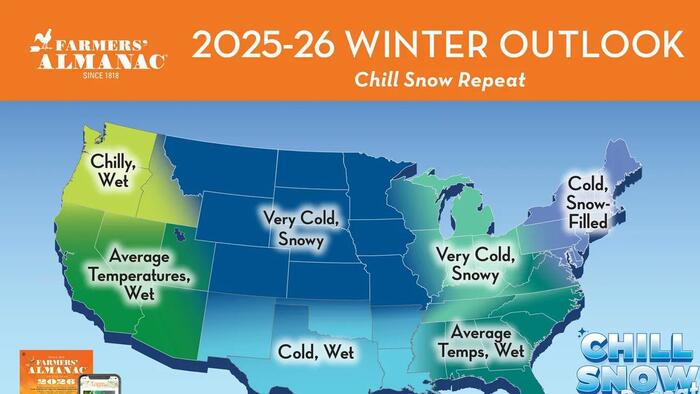
Cold Zones:
Coldest: Northern Plains to New England, plus Northwest (Idaho, Washington).
Major cold snaps expected mid-January and mid-February.
Snow Outlook:
New England: Frequent snowstorms.
Atlantic Coast: Significant rain, occasional snow mix.
Mid-Atlantic Mountains: Decent snow events.
Great Lakes, Ohio Valley, North Central: Classic snow-heavy winter.
Pacific Northwest Mountains: Impressive snow totals.
Regional Highlights:
Southeast: Average temps, wet;
Appalachians see occasional snow.
Texas/Southern Plains: Wetter than average, periodic cold snaps, limited snow but freezing rain possible.
Southwest: Wet winter, near-average temps
https://www.zerohedge.com/weather/farmers-almanac-unveils-long-range-forecast-widespread-wintry-weather-across-us
If you're worried about ticks, put up an owl box.
The animal driving most Lyme disease in the eastern US is the white-footed mouse. Ticks that feed on them are far more likely to come away infected than ticks that feed on other animals. The bigger the local mouse population, the worse the next year's tick year.
A single barred owl pair raising chicks can take hundreds of rodents in a breeding season. Owls also don't carry Lyme. The bacterium can't survive their digestive tract, so an owl that eats an infected mouse is a dead end for the disease.
Researchers at the Cary Institute, the leading lab on Lyme ecology, have been explicit about this: "Landscapes that support predators have reduced Lyme disease risk."
One owl box on its own isn't going to fix a tick year. But a yard with owls, foxes, bobcats, and weasels in it has fewer mice, and a yard with fewer mice has fewer infected ticks.
If you have woods or fields nearby, a properly sized barn owl or screech owl box (different species, different ...
The "fly brain" controlled release is likely what has the big AI labs spooked.
We are running fly brains in web browsers while creating emergent properties quite easily.
Google Research would not have released their most cutting edge or capable brain for the masses to mess around with and we can assume that they now have internal access to artificial brains which rival human capabilities and beyond.
Now imagine those artificial super brains in hyper scale data centers that run massive arrays of them.
In 2021, I first heard of artificial brains being used to control satellites and brushed it off as science fiction.
God created humans. Humans created LLMs. And LLMs now seem to be creating artificial brains and potentially artificial consciousness.
You should embrace as much of the new technology as you are allowed to access.
Acceleration is inevitable.
Dario has written that we need to “pace the frontier,” and Sam has agreed. People may be surprised by my response: go ahead.
You guys are the frontier. By any reasonable metric — market share, revenue growth, model capability — the two of you have a duopoly on frontier intelligence. You’ve also claimed the lead is widening because of recursive self-improvement.
I don’t see what you see in the lab. If the unreleased models are scary enough that you think you should slow down, I support your decision to be responsible.
But stop pretending you need anyone else’s permission. Stop pretending antitrust law has to be suspended so you can form a cartel. Stop pretending you need a regulatory approval process that supersedes product liability. Stop pretending METR is independent when it is intertwined with Anthropic’s investors and staff. Stop pretending you need those same evaluators to police competitors who aren’t even at the frontier.
Most of all, stop pretending the motivation to ...