

Email today to buy or store your DASEIN System 6 can carton today.
[email protected]

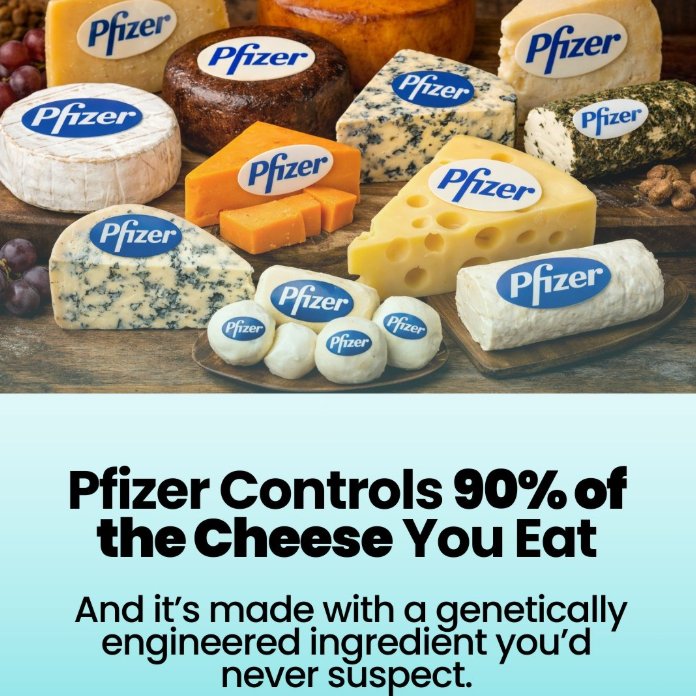
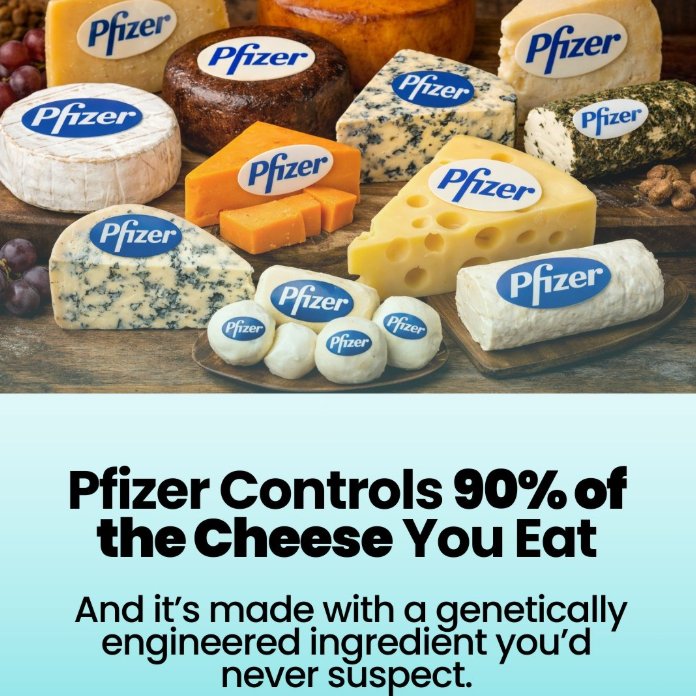
You think you're just eating "cheese"?
Think again.
90% of the American cheese on store shelves right now is made with a lab-engineered fake rennet called FPC — fermentation-produced chymosin.
And it was originally developed and patented by Pfizer in 1990. Yeah, that Pfizer.
Here's how they did it: They took the gene for chymosin (the key clotting enzyme from a calf's stomach), spliced it into Aspergillus Niger — black mold — using CRISPR gene-editing tech, then let the mold ferment in giant vats like some dystopian bio-reactor. The result? A synthetic enzyme that's cheaper, faster, and more consistent than the real thing.
Big Food loved it. No more baby calves. No supply limits. Just endless, uniform cheese bricks rolling off the line. FDA called it "substantially equivalent" to real rennet and gave it GRAS status with zero long-term human safety studies — just a 90-day rat trial. Sound familiar?
The worst part? This stuff isn't even listed properly.
On ingredient labels it hides behind vague wording:
- "enzymes"
- "microbial enzymes"
- "vegetarian rennet"
- or just plain "rennet"
And here's where it gets insidious: Plenty of people are getting bloating, digestive distress, skin issues, or straight-up allergic reactions after eating cheese... and they blame "dairy." But a growing number are realizing it's not the milk — it's the A. Niger residue or the GM process itself triggering the problem.
Real animal rennet? That's the traditional calf-stomach enzyme our ancestors used for thousands of years. It works with your body. No hidden mold genes.
Want the real stuff?
How to actually avoid this garbage:
- Look for labels that specifically say "animal rennet" or "calf rennet"
- Skip anything that says "microbial," "vegetarian," or just "enzymes"
- Buy European imports, artisanal, or raw-milk cheeses (they still use the old-school stuff)
- Certified Organic or Non-GMO Project Verified is safer (many ban FPC outright)
- Best move: find a local cheesemaker who tells you exactly what they use
They turned one of the oldest, most nutrient-dense foods on earth into another ultra-processed Franken-food and hoped you'd never notice.
Stop eating their science experiment.
Your gut (and your ancestors) will thank you.
https://x.com/i/status/2044415454010134931
If you're worried about ticks, put up an owl box.
The animal driving most Lyme disease in the eastern US is the white-footed mouse. Ticks that feed on them are far more likely to come away infected than ticks that feed on other animals. The bigger the local mouse population, the worse the next year's tick year.
A single barred owl pair raising chicks can take hundreds of rodents in a breeding season. Owls also don't carry Lyme. The bacterium can't survive their digestive tract, so an owl that eats an infected mouse is a dead end for the disease.
Researchers at the Cary Institute, the leading lab on Lyme ecology, have been explicit about this: "Landscapes that support predators have reduced Lyme disease risk."
One owl box on its own isn't going to fix a tick year. But a yard with owls, foxes, bobcats, and weasels in it has fewer mice, and a yard with fewer mice has fewer infected ticks.
If you have woods or fields nearby, a properly sized barn owl or screech owl box (different species, different ...
The "fly brain" controlled release is likely what has the big AI labs spooked.
We are running fly brains in web browsers while creating emergent properties quite easily.
Google Research would not have released their most cutting edge or capable brain for the masses to mess around with and we can assume that they now have internal access to artificial brains which rival human capabilities and beyond.
Now imagine those artificial super brains in hyper scale data centers that run massive arrays of them.
In 2021, I first heard of artificial brains being used to control satellites and brushed it off as science fiction.
God created humans. Humans created LLMs. And LLMs now seem to be creating artificial brains and potentially artificial consciousness.
You should embrace as much of the new technology as you are allowed to access.
Acceleration is inevitable.
https://x.com/CodeMonkeyZ/status/2099170168442077247
There you go... This entire "AI is going to kill us" was an orchestrated psyop.
Dario Amodei was on @FaceNationCBS ...
Dario has written that we need to “pace the frontier,” and Sam has agreed. People may be surprised by my response: go ahead.
You guys are the frontier. By any reasonable metric — market share, revenue growth, model capability — the two of you have a duopoly on frontier intelligence. You’ve also claimed the lead is widening because of recursive self-improvement.
I don’t see what you see in the lab. If the unreleased models are scary enough that you think you should slow down, I support your decision to be responsible.
But stop pretending you need anyone else’s permission. Stop pretending antitrust law has to be suspended so you can form a cartel. Stop pretending you need a regulatory approval process that supersedes product liability. Stop pretending METR is independent when it is intertwined with Anthropic’s investors and staff. Stop pretending you need those same evaluators to police competitors who aren’t even at the frontier.
Most of all, stop pretending the motivation to ...